American GIs
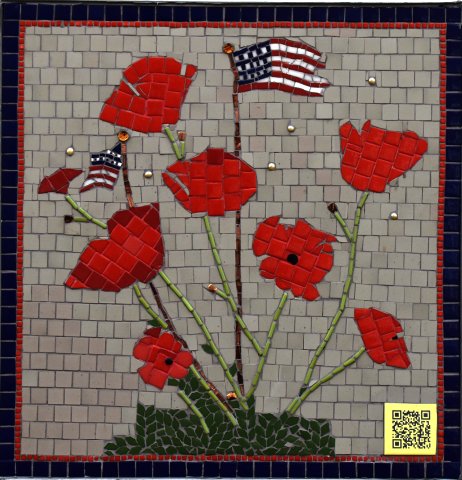
| Artwork | Jan Johnson |
| Maker(s) | Jan Johnson, |
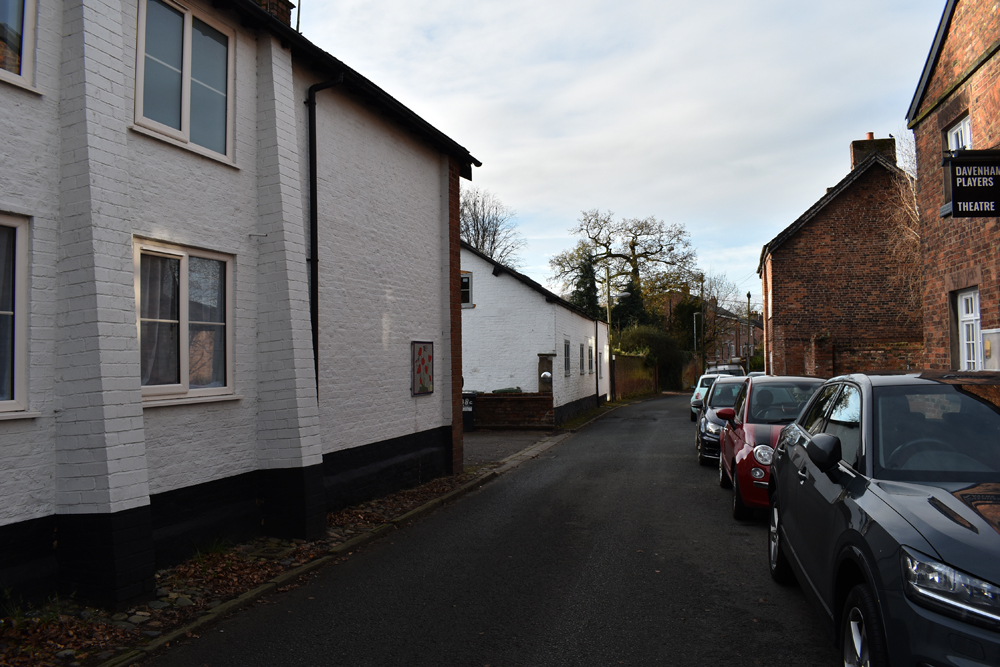
| Location | Thanks to Anna Daws, Emily Blears, Laura Blears - On wall of 38A Church Street, opposite the Theatre, CW9 8NF, https://w3w.co/popular.licks.retire |
| Sources | Northwich Guardian 8th May 2012 |
American Soldiers (GI’s) in Davenham
During the Second World War the residents of Davenham became the neighbours of American soldiers who were billeted in outbuildings at the Lodge in Church Street.
When Davenham Lodge was knocked down the outbuildings were retained and converted into dwellings. Emily who lived there remembers a man who came to look around the courtyard who wanted to see where the Americans had been billeted. He said he had been staying there during the war and had come back to see it again.
She recalls telling her parents of seeing three soldiers in her bedroom; the first at the end of her bed and two silhouetted in front of the wall, one of which wore a rucksack and both wearing tin hats.
The presence in the village of these Americans must have created quite a bit of interest especially in the children who were unused to foreigners as the following newspaper report shows
Gina Bebbington Northwich Guardian 8th May 2012 reported:
A TOUCHING friendship between a schoolgirl and a soldier spanned 70 years and more than 3,500 miles, despite the pair only ever meeting once.
Davenham girl Kay Jones, now Kay Bowyer, was eight years old when a group of American soldiers from the 1st Armoured Division moved into the village in 1942.
During the three months the soldiers were billeted in Church Street, Kay became friends with a man she knew as Bill.
When he left the village to take part in Operation Torch, the British-American invasion of French North Africa, they agreed to write to each other and this correspondence lasted throughout the Second World War and beyond.
The pair swapped news and pictures of their families and it was decades later when Kay discovered she had misheard Earl’s friends calling him by his surname – but he was always Bill to her.
Sadly, they never met again after 1942 and Earl died seven years ago.
But letters and cards continued to be sent across the Atlantic Ocean as Kay and her husband Frank wrote first to Earl’s wife Maxine and then to his children John, Jerry and Janice.
Kay and Frank went to visit Jerry and his wife Linda on a trip to America three years ago and, this month, the couple have come to England, giving Jerry the chance to walk in his father’s footsteps.
The Guardian caught up with the group in Church Street by the site of Davenham Lodge, where the soldiers lived but which was demolished to make way for housing in the 1970s.
Kay said: “The American soldiers were so lovely with the children and all the villagers, they had all the time in the world for us and people in the village were so hospitable to them.
“As they were leaving Bill asked if I would be his penfriend so I wrote to him and at the end of the war he went back to America, got married and had the children and I was sent pictures of these little babies.
“Eventually they got married and I got pictures of the grandchildren.”
She added: “My one regret is that we didn’t get a trip to America in before he died.”
Jerry said: “We grew up knowing Frank and Kay.
“Every Christmas they would send letters and cards and pictures and mum and dad always communicated with them.
“Dad never really talked about the war but the stories he told about the kids and about Kay were always intriguing.
“Now we’ve got all this technology – emails and Skype – it’s been great.
“It was a really cool experience to meet Frank and Kay for the first time – and this is our third summer together.”
Jerry said Earl only enlisted in the army for a year, in 1940, but the day he was due to be processed out was December 7, 1941, the day Pearl Harbour was bombed.
He could not leave and served for the rest of the war.
Jerry said: “He always said he felt he was the luckiest man alive because he saw so many comrades injured badly or killed but he came home.”